
How Much Does Tree Removal Cost in North Carolina?
One national cost guide puts the national average for tree removal at $750. Most homeowners pay between $200 and $2,000, it says. Its state table lists North Carolina at $600 to $900 on average.
These are market numbers, not our price list. The guide ties that range to the tree’s height, its trunk size and how close it stands to buildings. On a mountain lot, slope and access come into it too.
What does tree removal cost by height?
Another national guide sets tree removal prices by height. Here is its table.
| Tree height | Typical cost in one national guide |
|---|---|
| Small (under 30 feet) | $200 to $500 |
| Medium (30 to 60 feet) | $500 to $1,500 |
| Large (60 to 80 feet) | $850 to $2,000 |
| Extra-large (over 80 feet) | $1,200 to $2,500 and up |
Trunk size counts too. That guide says trunks over 24 inches across cost a good deal more to remove. A tall tree with a thick trunk can land at the top of the table or past it.
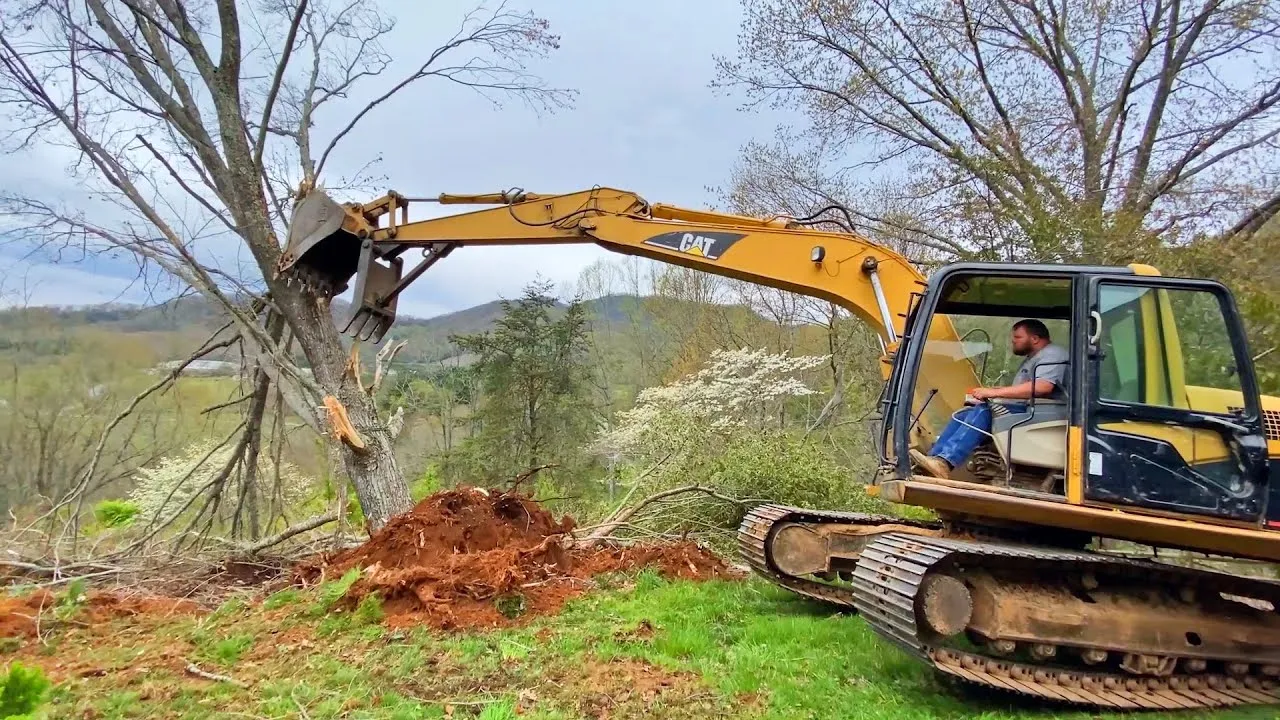
Our tree removal work runs on excavators and a dump truck. The excavator brings the tree down where there is room, and the dump truck hauls the wood off.
Does a dead or storm-damaged tree cost more to remove?
It can. One guide says a dead tree often costs more to remove, not less. The reason is the added safety risk.
Dead hemlocks are one mountain example. The state forest service says the hemlock woolly adelgid infests the entire native range of hemlocks in the state. Where this insect has spread, hemlock deaths are apparent and will likely keep increasing.
Hurricane Helene left another risk behind. The extension service says trees that survived Helene may be more likely to blow over in relatively mild winds. Their wood was likely damaged even if they did not fall. Under stress, wood can separate in layers and roots can break.
The extension service also lists leaning trees, cavities and hollow areas among the trees at risk in storms. Its storm advice includes removing branches within 30 feet of houses or structures.
How does what sits under the tree change the price?
A tree with open ground around it is the simple case. The excavator reaches the trunk and lays the tree down in a clear spot. The closer a tree stands to the house, the more care the job takes.
A tree leaning over the roof or a power line is a different kind of job. With no room to fall, it needs a climber or a crane. One guide says crane service adds about $250 to $600 per day. After a storm, the extension service says to start by checking the site for safety and for downed power lines.
Does a steep lot or a hard-to-reach tree cost more?
A mountain lot can be steep or rocky. A tree on a steep bank or behind the house takes more setup than one beside the driveway. The excavator needs a place to sit and room to reach the trunk.
The large excavator handles big trunks, and the small one fits tighter yards. Which machine fits, and how far the wood travels to the dump truck, both shape the quote.
Why does storm work cost more?
Rushed work after a big storm costs more. One guide says rushed removal of a hazardous tree often costs 2 to 3 times the standard rate. Another says removal after a storm, when demand is high, can reach $5,000.
A tree already on the ground can cost less. One guide says an uprooted or fallen tree can cost as little as $300 to $500. The job is only cutting it up and hauling it away.
Storms often leave more than wood behind. When a falling tree crushes a shed or a fence, our storm debris removal hauls off the wreckage.
What extras add to the price?
One national guide lists these add-ons.
| Add-on | Typical cost in one national guide |
|---|---|
| Stump removal | $100 to $500 and up per stump |
| Wood chipping | $50 to $100 |
| Log splitting | $50 to $100 |
Stump size and the removal method set the stump price. If you want the stump out, the excavator can pull it, and that work goes with land clearing. A lot with many trees or stumps to clear is a land clearing job too. See what land clearing costs per acre in North Carolina.
Hauling is the line to check. Ask whether the price takes the wood off the lot or leaves it in a pile. On our jobs, the dump truck hauls the wood and brush away.
Does homeowners insurance pay for tree removal?
Sometimes. One guide says homeowners insurance usually covers removal when a tree damages a covered structure, such as the house. It puts typical coverage at $500 to $1,000 per tree.
A tree that falls in the yard without damage is generally not covered. Your own policy has the final word, so ask your insurance agent before the work starts.
What should a written tree removal quote cover?
A written quote lets you compare two prices for the same work. It should spell out:
- Which trees come down
- Whether the stump comes out
- Whether the wood is hauled off or left on the lot
- Whether limbs and brush leave too
- Any add-ons, each on its own line
How do you get a number for your own trees?
The ranges above are a starting point. Your number depends on the tree, what sits under it and how the excavator gets to it.
Sanders Contracting is based in Murphy and does tree removal across western North Carolina and the tri-state area. We look at the tree and put the quote in writing. It covers what comes down, the stump if you want it out, and what leaves the lot.
See how the work runs on our tree removal page. Call or text (828) 342-1467 to set up a look at your trees.